

TL;DR
- Qwoted is a free-to-join platform where journalists post requests for expert sources and experts or PR teams pitch answers to them.
- The free Basic plan allows 2 pitches a month with a two-hour delay. Pro costs $149/month for 35 pitches, and Teams is custom-priced with unlimited pitches.
- Qwoted runs Pangram’s AI detection on pitches, so journalists can see when a quote reads as machine-written.
- It’s a good fit for experts and agencies that can answer requests within hours. It costs more per pitch than HARO, which is free for sources.
- HARO sends journalist queries in email digests three times a day, while Qwoted is a platform with searchable expert profiles, real-time alerts, and pitch limits that depend on your plan.
Qwoted connects journalists who need an expert quote with the people and PR teams who can supply one. A quote that runs usually brings a brand mention, a boost to your credibility, and sometimes a link.
If you’re wondering how Qwoted compares with HARO and other platforms, we’re glad to walk you through it. This review explains how Qwoted works, what each plan costs, how we pitch on the platform, and where it falls short.
We started using Qwoted in 2022 and we quickly found that it worked best for experts with established, verifiable LinkedIn profiles. Our tech and SaaS clients were approved without trouble, while owners of smaller businesses that were harder to verify were more likely to be declined.
What Is Qwoted?
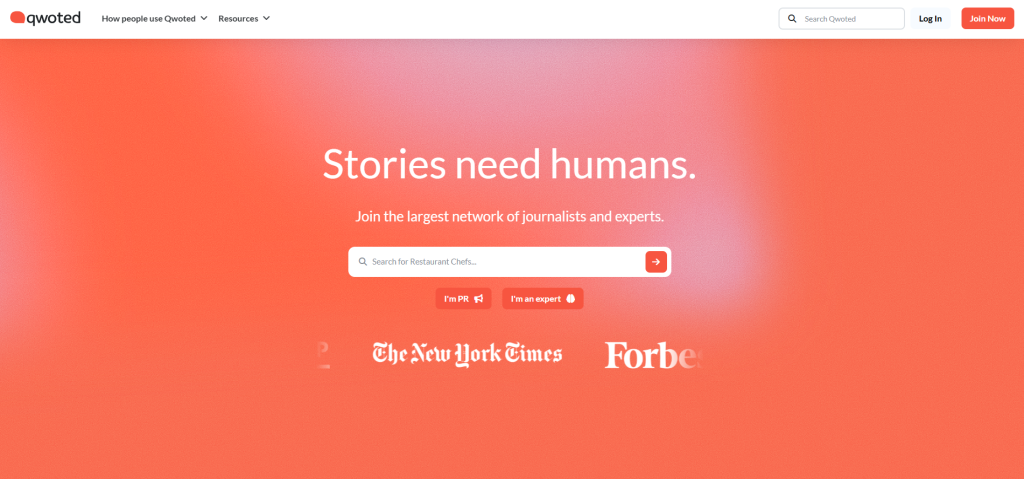
Qwoted is a media request platform. Journalists post story requests describing the source they need, and experts, small businesses, and PR professionals reply with pitches through the platform. Journalists join for free, and sources can join on a free plan or pay for more pitches and research tools.
Qwoted helps you reach audiences through media outlets without cold pitching, and it can sit alongside your other PR tools and your social media promotion as part of a wider PR strategy. The main draw is relevant opportunities: requests matched to your topics instead of a general inbox of leads.
A quote in a published story adds credibility to your brand, and it’s possible to get quoted in national and major publications, although results vary by topic and by pitch.
How Qwoted Works
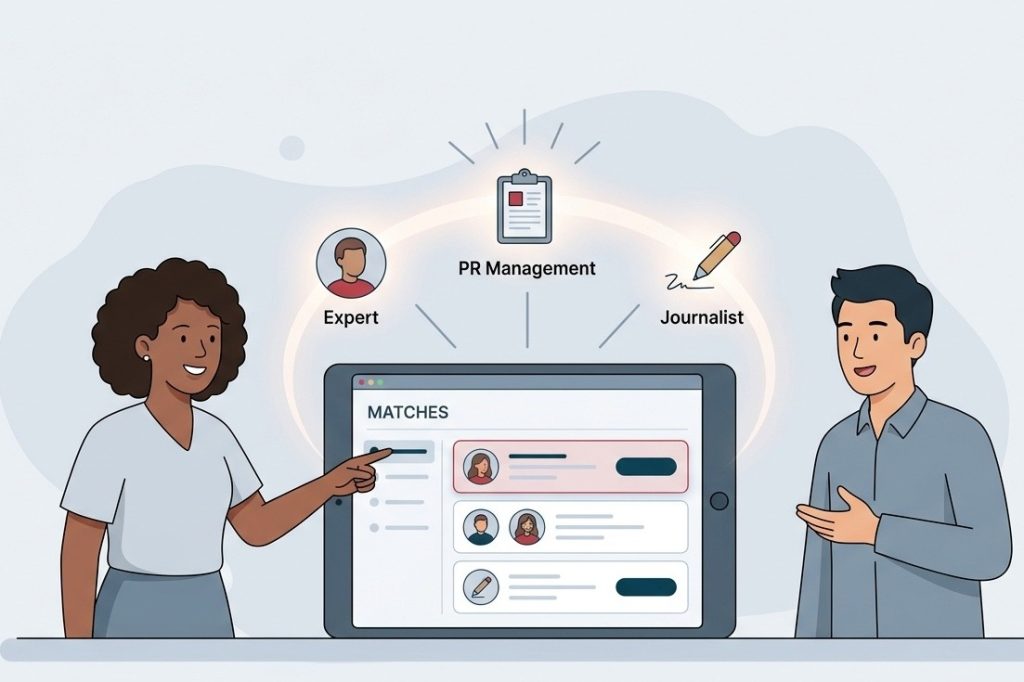
Each user type sees a different side of the same request feed. Here is what experts, PR teams, and journalists each do on the platform.
For Experts and Small Businesses
You create an expert profile with your role, credentials, and topics. That profile appears in the expert database journalists search. Qwoted then sends real-time alerts and a daily email of open requests that match your topics, so email alerts bring media opportunities to you without a lot of hunting.
When a request fits, you write a pitch that answers the journalist’s questions directly. Your expertise and industry knowledge are what the journalist is after, so share specifics they can use.
If you tick Auto-Summarize on the pitch form, Qwoted’s AI writes a short summary that appears under “Recent Commentary” on your profile and in a Story Ideas feed reporters browse. A journalist who finds you there can message you directly, so one pitch can lead to future requests you never saw.
For PR Professionals and Agencies
PR teams pitch on behalf of clients from one account, and the Teams plan adds team functionality, white labeling, an admin dashboard, and weekly activity reports. That setup is key for agencies, because one person can run pitching for several client experts and report on it without separate logins.
In our experience, the pitch caps meant Qwoted couldn’t replace HARO for an agency pitching on behalf of several experts at once. Requests in many of our clients’ niches also came up too rarely to justify the cost. The requests that did come through were more curated, though, so a profile and a watch on relevant requests are still worth keeping for some clients.
For Journalists
Reporters post a request, receive pitches in their Qwoted dashboard, and close the request when they have enough sources. They can also search the expert database or browse Story Ideas, which is how some start conversations with experts who never saw the original request. Since the August 2025 Pangram integration, journalists see how much of each pitch was likely written by AI.
How To Use Qwoted to Earn Press Mentions
In our experience, the pitches that land answer the question in the first two lines and include one detail the journalist can’t find with a search. Here’s how to put that into practice:
- Set up one profile per expert. A complete profile builds credibility with journalists who search the expert database.
- Filter alerts to the expert’s topics. That way, you only see relevant opportunities and can spend your pitches where the expert knows the topic best.
- Pitch within 12 hours. The Qwoted team recommends responding within 12 hours, even when the deadline is days away, because early pitches get read first. Before you pitch, conduct a quick check of the deadline and the outlet so your answer fits the story.
- Write a strong pitch. Answer the journalist’s question directly, in your own voice, and add a specific insight only you can offer. If you’re pitching on an expert’s behalf, research the content and quotes they’ve already published online, including their LinkedIn profile, and ask them about their expertise and any insights they want to share, so the pitch sounds like them. The sample pitch below shows a format to follow.
- Track placements. Journalists rarely confirm when a story runs, so we track Qwoted placements the same way we track our HARO work: Google Alerts on each expert’s name and company, and Ahrefs to catch new links. Once a quote runs, share it on social media and on your blog to get more out of it.
Qwoted Features We Liked The Most
Qwoted’s features cover finding requests, judging whether to pitch, and getting found by journalists who aren’t posting requests. These are the ones that affect results most.
Real-Time Alerts and the Daily Email
Every plan, including Basic, gets real-time alerts and the daily opportunities email. Real-time alerts are the more useful of the two, since a pitch sent within the first few hours competes with fewer replies. Your competitors in the same industry are seeing the same requests, so speed counts.
Pitch Intelligence
Pitch Intelligence is a Pro and Teams feature that shows how competitive a request is before you pitch. With 35 pitches a month on Pro, it helps you spend them on requests where your pitch won’t be one of many so that you have a better chance of winning them. Pro gives you all that, plus opportunity research.
Expert Database and Story Ideas
Every plan puts your profile in the expert database journalists search, so a complete profile can bring inbound requests. Story Ideas extends this by showing summaries of your past pitches to reporters looking for angles. Over time, this builds a record of your insights that journalists can browse.
AI Detection on Pitches
Qwoted partnered with Pangram in August 2025 to flag AI-generated text in pitches, according to the announcement on Business Wire. Journalists see the flag in their dashboard. Qwoted’s help center warns that even light AI grammar edits can trigger it, and many publications can’t use AI-written quotes at all, so pitches need to be written by a person.
The tool isn’t perfect, though, and can sometimes flag pitches that weren’t AI-generated.

Qwoted Pricing
Qwoted has a free plan and two paid plans for sources:
| Plan | Price | Pitches per month | Pitch delay | Main additions |
| Basic | Free | 2 | 2 hours | Expert database listing, real-time alerts, daily opportunities email |
| Pro | $149/mo | 35 | None | Pitch Intelligence, opportunity research, events and awards database |
| Teams | Custom | Unlimited | None | Team functionality, white labeling, admin dashboard, weekly activity reports, profile view alerts, premium support |
Pro works out to about $4.26 per pitch if you use all 35. Two free pitches a month is enough to test whether requests in your niche come up often, but not enough to run a steady pitching program.
Sample Qwoted Pitch
We’ve found that a good pitch follows the format Qwoted recommends: a short introduction, a direct answer to each question, and a close with contact details. Qwoted suggests 7 to 12 sentences. The template below follows that structure for a request about content marketing budgets.
Request (example): “Looking for marketing leaders: how should a small business split its content budget between writing and promotion in 2027?”
Pitch:
Hi [journalist’s first name],
I’m [name], [role] at [company], where we [one line on what the company does and for whom]. [One credential, such as years in the field or a past media mention.]
[Direct answer in one or two sentences, for example the split you recommend and the condition it depends on.]
[One specific detail from your own work, such as a number from client data or a pattern you’ve seen across accounts, written as a sentence the journalist can quote as is.]
[One sentence on the most common mistake you see and what it costs.]
Happy to expand on any of this or jump on a quick call before your deadline. My headshot and bio are on my Qwoted profile, and you can link to [company website] if you use the quote.
Thanks,
[Name]
Pitching Tips
A few tips and practices make the template work better:
- Answer the question in the first two lines, then add detail.
- Share insights from your own client work, such as what your customers ask most, instead of general advice.
- Write the pitch yourself so it passes AI detection and sounds like you.
- Send it early, since the success of a pitch often depends on being read before the journalist has enough sources.

Qwoted Pros and Cons
Qwoted’s strengths come from how requests and pitches are managed. Its weaknesses are mostly about cost and volume.
Pros
- Free to start: The Basic plan includes a profile, alerts, and the daily email at no cost.
- Request status is visible: Journalists close requests when they’re done, so you don’t pitch stories that are already filled.
- Inbound exposure: The expert database and Story Ideas let journalists find you without a posted request.
- AI screening: Pangram detection filters out machine-written pitches, which helps sources who write their own.
- Agency features: Teams adds white-labeling and reporting for agencies pitching for several clients.
- Relevant opportunities: Qwoted connects you with relevant journalists and outlets, which saves time compared with cold outreach.
Cons
- Tight free plan: Two pitches a month with a two-hour delay limits the free plan to testing.
- Pitch caps on Pro: At 35 pitches a month, an agency pitching for several experts will need Teams.
- No guarantee of a link: A published quote may name your brand without linking to your site.
- Accounts can be disabled without explanation: Many users say their accounts were disabled or restricted without warning, sometimes before they had used the platform.
- AI detection challenges: Some users say clearly human-written pitches were flagged as AI-generated.
- Strict verification: Experts with verifiable LinkedIn profiles are approved easily, but in our experience, owners of smaller businesses that were harder to verify were more likely to be declined.
Qwoted vs HARO
Qwoted is one of several journalist request services, and the main differences are price and how requests reach you. Here’s how Qwoted stacks up against HARO as an alternative.
HARO (Help a Reporter Out) sends sources email digests of journalist queries, and subscribing is free.
How requests reach you is the biggest difference. HARO works like an inbox: you scan a digest, pick the queries that fit, and reply. Qwoted works like a platform: you keep a profile, get real-time alerts and a daily email, and pitch from a dashboard, so you see a request when it’s posted instead of waiting for the next digest.
Visibility is another. On Qwoted, journalists can search the expert database and browse Story Ideas, so a complete profile can bring you inbound requests. HARO is built around answering queries as they arrive.
HARO costs sources nothing, while Qwoted’s free plan caps you at 2 pitches a month and Pro costs $149/month.
Quality control differs too. Qwoted vets its users and runs AI detection on pitches, which cuts down on noise for journalists. That helps if you write your own pitches. It’s a risk if a flag is wrong, as some Trustpilot reviewers say it was for them.
In our experience running HARO outreach for clients, a free daily digest means many sources see the same query, so a fast, specific pitch matters most. Pitching on Qwoted follows the same request-and-reply model, so the habits that earn HARO placements carry over.
If you want volume at no cost, start with HARO. If you want a searchable profile and more control over where you spend pitches, Qwoted offers that. You can also use both, since neither stops you from using the other.
| Platform | Cost for sources | How requests arrive | Best for |
| Qwoted | Free (2 pitches/month) or $149/month for Pro | Real-time alerts, daily email, and a searchable expert profile | Experts and agencies pitching regularly |
| HARO | Free | Email digests three times a day | Sources who want volume at no cost |

Who Is Qwoted Best For?
Qwoted suits experts with clear credentials in a defined topic, and agencies that can turn pitches around within hours. It works especially well for thought leaders and industry specialists who can share first-hand knowledge. And it fits link builders who want brand mentions in news coverage, since a quoted expert is named with their company even when the story carries no link.
Look elsewhere if you can only pitch occasionally, because the free plan’s two pitches won’t produce steady results. If you need a guaranteed number of links, a request platform can’t promise that, and a managed outreach service is a better fit.
Get Expert Placements Without Running the Pitching Yourself
Earning press mentions on Qwoted depends on checking journalist requests every day and sending a well-written pitch within hours.
If your team doesn’t have that time, Contentellect’s outreach team checks requests daily and writes pitches in your experts’ voice to help land your brand on high-authority publications.
See our HARO link building service for packages and pricing.
Frequently Asked Questions About Qwoted
How much is a Qwoted subscription?
Qwoted Pro costs $149/month for 35 pitches, and the Teams plan has custom pricing with unlimited pitches. The Basic plan is free with 2 pitches a month.
Do you have to pay for Qwoted?
No. Journalists use Qwoted for free, and sources can join the free Basic plan. You pay only if you need more than 2 pitches a month or want Pro tools such as Pitch Intelligence.
How does Qwoted work?
Journalists post requests for sources, Qwoted alerts experts whose profiles match the topic, and experts reply with pitches. The journalist picks the pitches to quote and closes the request when the story is covered.
What does Qwoted mean?
The name is a respelling of “quoted,” the result sources want from the platform: being quoted by name in a published story.
Is Qwoted good for backlinks?
It can be, but links aren’t guaranteed. Some publications link to quoted sources and some only mention them by name. The same is true of HARO backlinks, where many placements are nofollow links or unlinked mentions.
