

SGE SEO is one of the most important topics in digital marketing right now. As Google rolls out its Search Generative Experience (SGE), search engine optimization is evolving faster than ever before.
Instead of focusing only on ranking in the familiar 10 blue links, marketers must now adapt to a search landscape where AI-generated overviews and interactive follow-up questions dominate the search engine results page.
Understanding how SGE SEO works is not optional. It’s the difference between sustaining organic traffic and losing visibility to competitors who adapt first.
Fortunately, we’re here to explain what SGE is and how it’s changing search queries. We’ll also cover how you can refine your SEO strategy to thrive in Google’s generative AI era.
What Is Google’s Search Generative Experience (SGE)?
SGE stands for Google’s Search Generative Experience, a new approach to search powered by generative artificial intelligence.
Instead of returning only a list of ranked pages, Google SGE provides a synthesized AI-generated snapshot at the top of the search results. These summaries aim to directly answer the user’s query with concise, conversational responses built from multiple resources across the web.
SGE represents a shift from traditional search results. In the past, users typed a keyword into the search bar, then clicked through organic results or paid search ads to find information.
With the new AI integration, Google search looks very different.
A typical SGE result includes:
- An AI-generated answer box that summarizes key points from high-quality content.
- Citations and links to sources used in generating the snapshot, allowing users to dig deeper.
- Visual enhancements such as images, product carousels, and videos.
- Interactive features like follow-up questions that enable users to refine queries conversationally without restarting the search.
Is SGE Still Experimental?
SGE began as an opt-in feature within Google’s Search Labs. But now, in late 2025, it has moved well beyond the experimental phase.
Many users now see AI Overviews and conversational snapshots directly in search results without joining Search Labs, especially in the U.S. and English-language markets.
Google has already expanded AI search features to more than 200 countries and territories, making it clear that this shift is not limited to a few test regions. Some markets still see a gradual rollout, but for most, you’ll find that SGE is already a default part of the Google AI search experience.
This means competition is no longer just about keyword rankings. Success now depends on whether your content is selected and cited inside Google’s generative overviews.
How SGE Works Behind the Scenes
To understand how SGE affects your SEO efforts, it helps to look at how Google builds these AI-powered results.
Traditional search results are ranked based on algorithms like PageRank and keyword relevance. SGE uses large language models (LLMs) and natural language processing to create conversational, synthesized responses.
Here’s what happens:
- Generative AI modeling: Google’s AI analyzes indexed web content, relying on machine learning models to interpret the user’s query. It identifies intent and context instead of returning just keyword matches.
- Snapshot creation: The system generates a “snapshot” answer to present the most relevant insights in natural language. This can include value cards, product viewers, and even code snippets for technical queries.
- Cross-verification: To ensure trustworthiness, SGE cross-checks information against multiple high-authority sources before showing it in the AI-generated results.
- Citation panel: Alongside the snapshot, Google displays citations and links, allowing users to click into deeper content. This is where you want your web content to appear.
- Interactive refinement: The search generative experience enables users to ask follow-up questions directly in the search results, which extends engagement and reshapes how users interact with search engines.
A New Kind of Organic Search Results
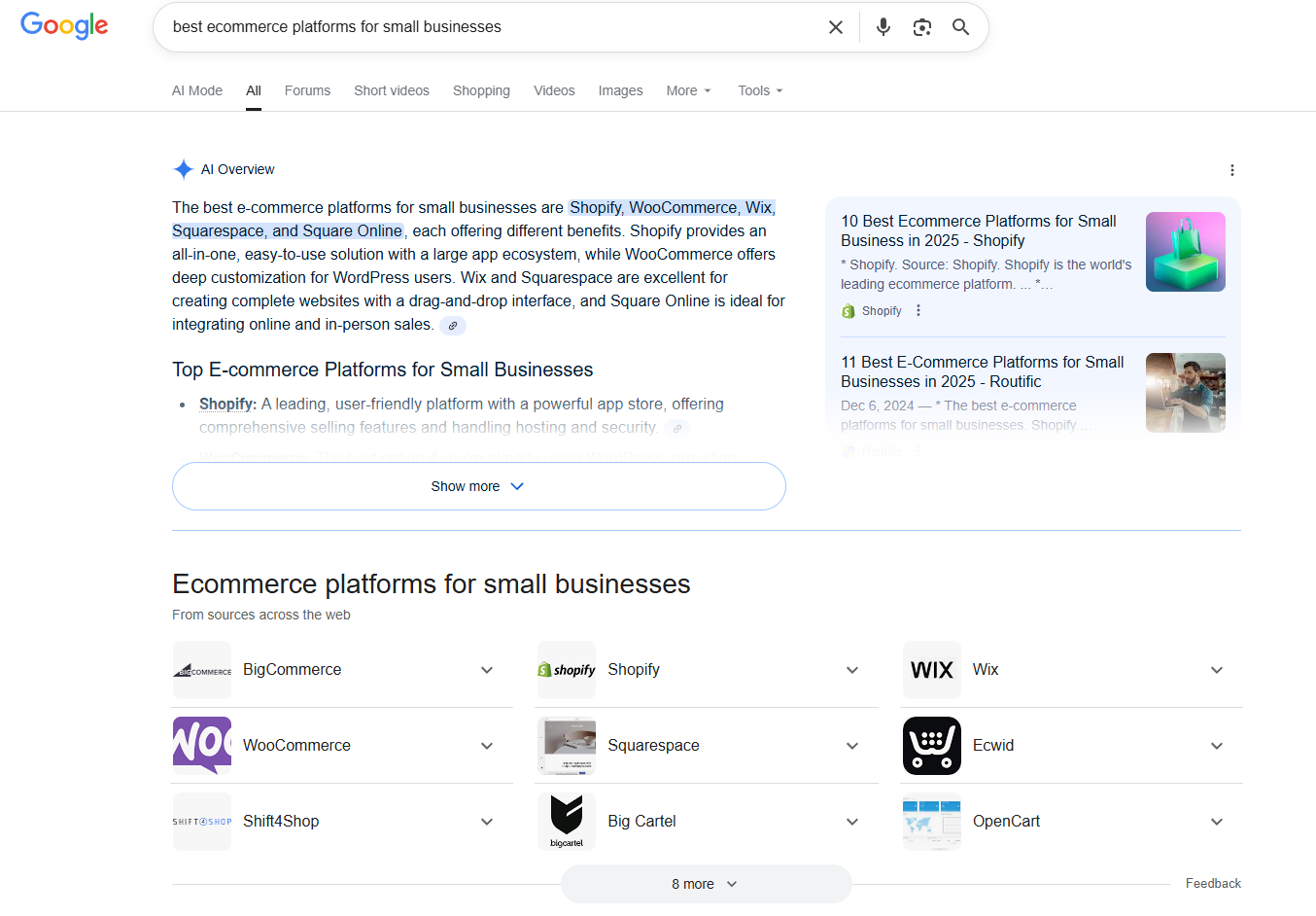
As an example, if you search “best ecommerce platforms for small businesses,” the snapshot displays an AI Overview with three cited articles right at the top. Only after that do you see the traditional search results.
Instead of scrolling, you can enter Dive Deeper mode, where Google surfaces additional insights, comparisons, and follow-up prompts that help you refine your search without starting over.
This combination of generative artificial intelligence and structured data marks a major evolution in how you interact with Google search. It creates both opportunities and challenges for capturing organic traffic.
SGE vs. SEO: What’s the Difference?
SGE and SEO are not interchangeable, but they are connected. Traditional SEO focuses on ranking your pages in the organic search results through keyword optimization, backlinks, and technical improvements. Good SEO practices help your pages climb the rankings and drive clicks to your website.
With SGE, the focus is whether your content gets cited inside Google’s AI-generated snapshots. You’re no longer just competing for position one through ten. You’re competing to be the source that Google’s AI trusts enough to reference directly in its AI overview.
But this doesn’t mean traditional SEO is obsolete. Far from it. The same signals that drive rankings (quality content, authority, structured data, and user intent) still matter. But under SGE, those signals are evaluated differently.
Google’s generative AI prioritizes clarity, freshness, and conversational relevance over keyword density alone. In practice, SGE SEO is an evolution of traditional SEO.
Why Google SGE Matters for SEO
SGE matters for SEO because it changes how users interact with search engines and how content is surfaced.
Organic search traffic has long been the backbone of digital growth, but under SGE, visibility now depends on whether your content is included in AI-generated responses.
There are three critical impacts on SEO performance:
- Zero-click searches increase: With AI-generated responses answering queries directly in the search bar, more users may get what they need without clicking through – resulting in more zero-click searches. This can reduce website traffic for businesses relying solely on top keyword rankings.
- Inclusion in snapshots replaces the top 10 rankings: Instead of obsessing over keyword rankings, SEO agencies must focus on becoming a trusted source that Google cites in its AI overviews. That requires authority, freshness, and clear formatting.
- E-E-A-T plays a bigger role: Experience, Expertise, Authoritativeness, and Trustworthiness (E-E-A-T) are essential. Google’s AI overviews prioritize content with clear authorship, expert input, and up-to-date reviews.
This means businesses must adapt their SEO strategy to ensure content creation aligns with user intent, conversational search, and structured data signals.
In our experience at Contentellect, this is where scalable, helpful content makes the difference. Sites that invest in good content, detailed schema markup, and clear authority signals (expert bylines, transparent author credentials, cited sources, and consistently updated data) will continue to perform well in both traditional SEO and SGE results.

Key Benefits of Google’s Search Generative Experience for Users and Businesses
Both search users and businesses can benefit when AI overviews surface high-quality, relevant content. Adapting to SGE SEO is not just about survival, but about unlocking new opportunities for growth.
Benefits for Users
While much of the conversation around SGE SEO focuses on the challenges, there are also important benefits for both search users and businesses that adapt early.
For users, the experience is more natural and efficient. Instead of clicking through multiple search engine results, they can see a synthesized overview that connects the most relevant content together.
This makes complex topics easier to understand and reduces the need for endless back-and-forth queries. The addition of follow-up questions in the search results also enables users to refine their search intent quickly without having to start the search process over.
Benefits for Businesses
For businesses, SGE SEO opens the door to new opportunities for visibility. Being cited in Google’s AI-generated responses puts your brand front and center, even if you aren’t in the first few organic results.
Appearing in SGE results is actually more valuable than a traditional top-three placement because the content is embedded directly in the AI overview that users are reading first.
SGE citations signal authority and trust. When your content is referenced in an AI overview, users associate your brand with expertise in the topic, even if they don’t click immediately.
That brand exposure, combined with higher engagement from users refining their queries, can translate into stronger awareness and conversions over time.

The Drawbacks of SGE
Despite its advantages, the search generative experience also introduces some drawbacks:
Reduced Organic Traffic
The first limitation is the potential reduction in organic traffic. Since users can often find answers directly in the AI snapshot, click-through rates to individual websites decline.
This is especially true for simple queries where an AI-generated response is sufficient, like “When was Shopify founded?” or “What does SEO stand for?”
Businesses that relied on high search volume and informational traffic may need to adjust expectations.
Unclear Ranking Dynamics
Another drawback is the lack of clarity in ranking dynamics. Traditional SEO gave us measurable signals like keyword rankings and link equity.
With Google’s AI overviews, the signals are more opaque. It is not always obvious why one source is cited while another is not, which makes the SEO strategy more complex.
Accuracy Challenges
Finally, SGE introduces challenges around accuracy. Generative AI is powerful, but it can occasionally produce misleading or incorrect information, also referred to as “hallucinations”.
While Google is working to refine its models and cross-checking mechanisms, businesses must monitor how their content is represented in SGE results to ensure accuracy and alignment with their brand.

Adapting SEO and Content for SGE
Ranking in SGE requires signals that go beyond the traditional top 10 results. Think conversational search queries, structured markup, fresh content updates, and clear author expertise.
The following are key SEO content strategy shifts:
- Conversational, intent-driven content: Since users interact with SGE in natural language, optimizing for long-tail keywords and conversational phrasing is more important than ever. Content should answer questions directly and anticipate follow-up queries.
- Structured data and schema markup: Google relies heavily on structured data to identify context and relevance. Adding schema markup for articles, products, reviews, and FAQs helps position your content for inclusion in AI-generated responses.
- Fresh and updated content: Google’s AI prefers up-to-date statistics and information. A strong content refresh strategy ensures that pages remain relevant and accurate, improving the likelihood of being surfaced in SGE results.
- Rich media integration: AI-generated results often highlight images, charts, and videos (particularly YouTube clips) alongside text snapshots. Incorporating multimedia into your pages signals to Google that your content is engaging and comprehensive.
- Authority and trust signals: Businesses that cite reputable sources and display transparent company information build stronger credibility. E-E-A-T is a non-negotiable factor in SGE SEO.
In practice, marketers should reframe content creation as a multi-layered process:
- create high-quality text
- structure it for machines
- refresh it for accuracy
- enhance it with rich media
For SEO agencies, this shift creates a new value proposition. Clients no longer ask only for keyword rankings. They expect visibility in Google’s AI search results. Agencies that demonstrate expertise in SGE SEO position themselves to grow and expand.
Practical Next Steps for Adapting to SGE SEO
You don’t need to scrap everything you know about SEO. But you do need to optimize your content for AI search. The first steps involve aligning your existing strategy with how Google’s generative AI surfaces results. Here’s how.
Step 1: Audit Existing Content
Review your existing pages with two lenses:
- Clarity: Does the content answer questions directly in plain, natural language? For example, instead of saying “Our tool is effective for businesses,” write “Our tool helps small businesses reduce marketing costs by 25%.”
- Intent: Does it anticipate follow-up questions and guide users deeper? For instance, a blog on “email marketing best practices” should also answer “How often should I send emails?” or “What’s a good open rate?”
Use tools like Google Search Console and SEMRush’s Topic Research to identify gaps where users may need more context.
Step 2: Strengthen Authority Signals
Google’s AI-generated responses prioritize trustworthy sources. To reinforce credibility, build four authority markers into your content:
- Expert bylines with credentials, e.g., include “Written by Jane Smith, Certified Nutritionist.”
- Quotes or commentary from subject matter experts, like citing an industry leader or research analyst.
- Up-to-date reviews, statistics, or case studies are refreshed at least quarterly, so Google considers your page current.
- Citations from reputable, verifiable sources, such as Statista, HubSpot, or government websites.
You can also run your pages through Schema.org’s markup validator to check that bylines, reviews, and references are properly structured.
Step 3: Redefine ROI Metrics
Traditional SEO reports often revolve around rankings and traffic volume. Under SGE, you need to track two new visibility signals:
- Presence in AI snapshots: Search your target queries and check whether your content is cited in the AI Overview. Track this monthly as a new visibility metric.
- Engagement metrics: Use Google Analytics 4 or Hotjar to measure how long users stay and whether they engage with CTAs after arriving from an SGE-cited link. Longer dwell times and scroll depth indicate stronger alignment with intent.

Step 4: Partner for Scalable Content
You can’t adapt to SGE with one-off content updates. To stay visible, you need both scale and precision. Two actions make the difference here:
- Produce content at a consistent volume: Aim to publish four to eight optimized articles per month that target long-tail, conversational queries in your niche.
- Work with partners who specialize in SGE SEO: Choose providers who understand schema markup, authority signals, and content refreshing cycles.
At Contentellect, we have seen clients across SaaS and e-commerce thrive when they stick to a consistent publishing schedule instead of relying on ad hoc posts. This aligns with Google’s emphasis on helpful, regularly updated content as a factor in SGE visibility.
Conclusion: Future-Proofing Your SEO in the Age of SGE
SGE SEO represents a fundamental shift in how search engines connect users with information.
Traditional optimization revolved around climbing the top 10 results, but Google’s search generative experience prioritizes AI-generated overviews that answer queries directly in the results page.
For you, that means success depends on creating conversational, intent-driven content, supported by structured data and clear authority signals.
The good news is that this new search era rewards businesses that act decisively. If you commit to producing high-quality, helpful content, backed by transparency and expertise, you can secure visibility in Google’s AI overviews even in competitive markets.
The brands that adapt early will set the standard while others struggle to keep pace.
At Contentellect, we make that adaptation simple. Our content writing services are built to help agencies and marketing teams thrive in Google’s generative search environment. And with our white-label content services, agencies can scale effortlessly, offering clients future-proof SEO content without straining internal resources.
If you’re ready to capture visibility in AI-driven search, partner with us.
